

Maximizing Efficiency in South African Manufacturing: The Essential Role of PLC HMI Design in Automation
Industrial automation plays a crucial role in boosting productivity and maintaining competitiveness in South Africa’s manufacturing sector. In Gauteng, where cities like Pretoria, Johannesburg, Centurion, Midrand, and Rosslyn host many manufacturing plants, the integration of Programmable Logic Controllers (PLCs) and Human-Machine Interfaces (HMIs) has become essential. This article explains how PLC and HMI systems work together, their benefits, and practical advice for South African manufacturers aiming to improve operations through effective automation design.

Understanding PLC and HMI Systems
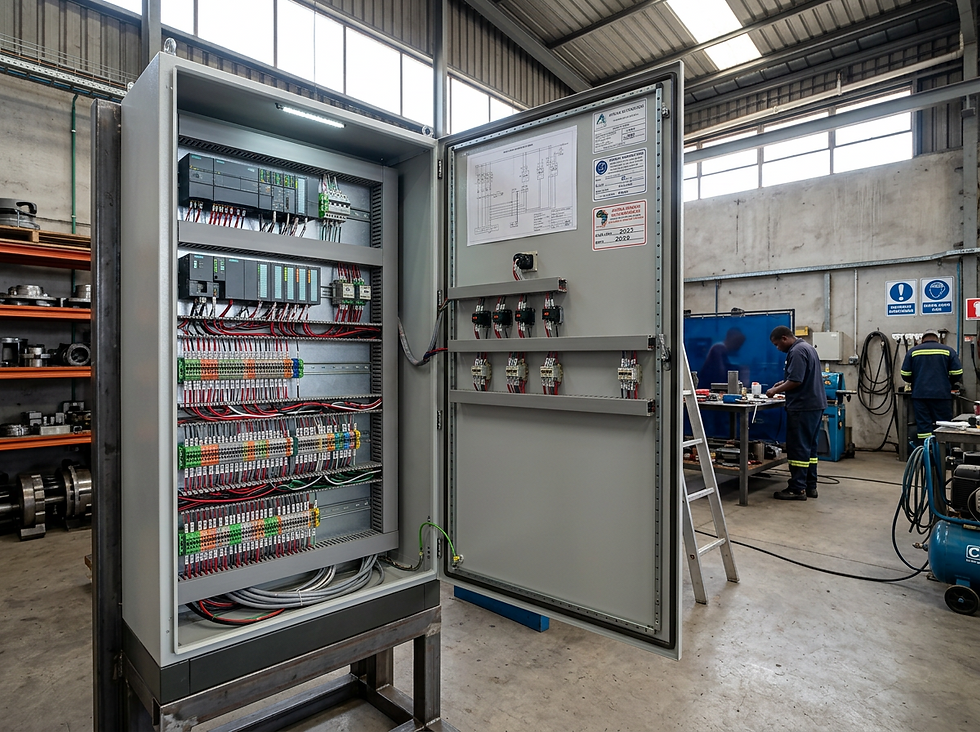
Programmable Logic Controllers (PLCs) are specialised computers designed to control machinery and processes in industrial environments. They receive input signals from sensors and switches, process these signals based on programmed logic, and send commands to actuators or machines. PLCs are known for their reliability, real-time operation, and ability to handle complex automation tasks.
Human-Machine Interfaces (HMIs) are the user interfaces that allow operators to interact with the automation system. HMIs display real-time data, system status, alarms, and controls on screens, enabling operators to monitor and adjust processes easily. They translate complex machine data into understandable visuals and controls.
Together, PLCs and HMIs form the backbone of industrial automation systems, enabling seamless communication between machines and human operators.
How PLCs and HMIs Work Together in Industrial Automation
PLCs execute control logic and manage machine operations, while HMIs provide a window into these operations for human users. The PLC continuously collects data from sensors and sends it to the HMI. The HMI then displays this data in graphical formats such as charts, gauges, and status indicators.
Operators use the HMI to send commands back to the PLC, such as starting or stopping machines, adjusting parameters, or acknowledging alarms. This two-way communication ensures that operators can respond quickly to changes and maintain smooth production.
In South African manufacturing plants, this interaction supports processes ranging from assembly lines in automotive factories to material handling in mining operations.
Key Benefits of PLC HMI Design in Manufacturing
Improved User Interaction and Operator Control
A well-designed HMI makes it easier for operators to understand machine status and control processes. Clear visuals reduce confusion and help operators make faster, more accurate decisions. This reduces the chance of human error, which can cause costly downtime or safety incidents.
Real-Time Monitoring and Data Logging
PLCs continuously monitor machine conditions and process variables. HMIs display this data instantly, allowing operators to detect issues early. Data logging capabilities enable manufacturers to track performance over time, identify trends, and plan maintenance proactively.
Enhanced Efficiency and Productivity
Automation with PLC HMI systems speeds up production by automating repetitive tasks and reducing manual intervention. Operators can optimise machine settings through the HMI, improving throughput and product quality.
Increased Safety
HMIs can display safety warnings and emergency stop controls prominently. PLCs can automatically shut down equipment if unsafe conditions are detected. This integration helps protect workers and equipment.
Flexibility and Scalability
PLC HMI systems can be customised to suit different machines and processes. As manufacturing needs evolve, new functions can be added without replacing the entire system. This flexibility is valuable for South African manufacturers adapting to changing market demands.
Cost Savings
By reducing downtime, improving quality, and lowering labour costs, PLC HMI automation delivers significant savings. Early detection of faults through real-time monitoring prevents expensive repairs and production losses.
How HMI Design Improves Operator Control and Reduces Errors
Effective HMI design focuses on clarity, simplicity, and responsiveness. Key design principles include:
Using intuitive graphics and icons that match operator expectations
Organising screens logically to minimise navigation time
Highlighting alarms and critical information with colours and sounds
Providing clear feedback when operators input commands
Limiting options to prevent accidental changes
In Gauteng’s busy manufacturing plants, operators often work under pressure. A user-friendly HMI reduces cognitive load and helps maintain focus, lowering the risk of mistakes that could halt production or cause safety hazards.
Integration of PLC HMI Systems with Machines, Sensors, and Automation
PLCs connect directly to sensors that measure temperature, pressure, speed, and other variables. They also control actuators like motors, valves, and conveyors. HMIs link to PLCs via communication protocols such as Modbus, Profibus, or Ethernet/IP.
This integration creates a networked automation system where machines, sensors, and control panels work together seamlessly. For example, in a food processing plant in Johannesburg, sensors detect product flow, the PLC adjusts conveyor speed, and the HMI displays production metrics for operators.
Real-World Applications in South African Industries
Manufacturing: Automotive assembly plants in Rosslyn use PLC HMI systems to coordinate robotic arms, paint booths, and quality inspection stations.
Food and Beverage: Breweries in Midrand rely on automation for precise temperature control and bottling line management.
Mining: Mining operations near Pretoria use PLCs and HMIs to monitor conveyor belts, crushers, and ventilation systems, improving safety and uptime.
Packaging: Packaging lines in Centurion employ PLC HMI designs to handle variable product sizes and speeds efficiently.
These examples show how automation tailored to local industry needs can improve competitiveness and sustainability.
Best Practices for PLC and HMI Design
Understand user needs: Involve operators and maintenance staff early to design interfaces that fit their workflows.
Keep interfaces simple: Avoid clutter and focus on essential information.
Use standard symbols and colours: This helps operators quickly interpret data.
Test designs in real environments: Simulate operations to identify usability issues.
Plan for scalability: Design systems that can grow with production demands.
Ensure reliable communication: Use robust protocols and hardware to prevent data loss.
Common Mistakes to Avoid
Overloading HMIs with too much information causing confusion.
Neglecting operator training on new systems.
Using inconsistent or unclear graphics.
Ignoring maintenance needs for PLC and HMI hardware.
Failing to plan for system updates or expansions.
Poor integration with existing machines and sensors.
Factors Affecting Implementation and System Performance
Quality of hardware and software: Reliable PLCs and HMIs reduce downtime.
Network infrastructure: Stable communication networks prevent data delays.
Environmental conditions: Dust, heat, and vibration in factories require rugged equipment.
Operator skill level: Training improves system use and troubleshooting.
Support and maintenance: Regular updates and repairs keep systems running smoothly.
Frequently Asked Questions
What are the benefits of PLC HMI design in industrial automation?
They improve user interaction, enable real-time monitoring, increase efficiency, enhance safety, support data logging, offer flexibility, and reduce costs.
What is the difference between a PLC and an HMI?
A PLC controls machines by processing input signals and sending commands. An HMI provides a user interface for operators to monitor and control the PLC and machines.
Can HMIs be integrated with custom machines?
Yes, HMIs can be programmed to work with custom machines by connecting to their PLCs or control systems, allowing tailored interfaces.
How do HMIs improve safety in industrial environments?
HMIs display alarms and safety warnings clearly and allow operators to quickly respond to emergencies. PLCs can also trigger automatic shutdowns based on sensor data.
What industries use PLC HMI systems?
Manufacturing, automotive, food and beverage, mining, packaging, and many other sectors rely on PLC HMI automation.
South African manufacturers in Gauteng and beyond can greatly benefit from well-designed PLC HMI systems. Companies like Emenem Industrial specialise in PLC design, control panel building, and automation integration services tailored to local industry needs. Investing in these solutions supports stronger, safer, and more efficient manufacturing operations.



Comments