

Your Factory Can Be Automated. But Who Will Maintain It?
A factory can be automated on paper long before it is maintainable in practice.
That gap is becoming more visible across South African manufacturing, especially in Gauteng, where plants are under pressure to increase output, reduce waste, protect margins, and cope with limited technical skills. Automation is often the right move. A well-designed automated line can improve consistency, safety, traceability, and production speed. It can also remove a great deal of manual guesswork from a process.
But automation does not remove maintenance. It changes the nature of maintenance.
The more automated a plant becomes, the less useful old boundaries become. Electrical, mechanical, instrumentation, controls, data, and production systems now overlap on the same machine. A filling line fault might start as a mechanical jam, show up as a drive trip, stop a PLC sequence, trigger a sensor alarm, and appear on SCADA as a production loss. If the team cannot read across those layers, the plant stays down while everyone waits for “the right person”.
That is the real question behind many automation projects in South Africa: not only can the factory be automated, but can it be kept running once it is?

Automation raises the technical bar for maintenance
Older plants were often easier to diagnose in a physical sense. A motor ran, or it did not. A contactor pulled in or it did not. A bearing was noisy, a belt was loose, a valve leaked, or a gearbox ran hot.
Those faults still exist. The mechanical and electrical fundamentals have not gone away. What has changed is the amount of control logic, feedback, communication, and software sitting around them.
On a modern automated plant, maintenance teams may need to understand:
PLC inputs, outputs, timers, interlocks, sequences, and fault logic
Variable speed drives, servo drives, soft starters, motor protection, and braking systems
Sensors for position, pressure, flow, level, temperature, weight, and vision
Instrumentation loops, calibration, scaling, and signal quality
Robotics, guarding, safety circuits, and recovery procedures
Industrial networks, remote I/O, managed switches, and communication faults
SCADA alarms, trends, recipes, batches, permissions, and event history
Mechanical alignment, pneumatics, hydraulics, lubrication, wear, and vibration
Electrical distribution, earthing, power quality, and panel condition
Data logging, dashboards, and the early use of AI-based alerts
That list is not there to make automation sound complicated for the sake of it. It reflects what maintenance work now looks like on the factory floor.
In a food plant in Johannesburg, a rejected product problem might not be caused by the reject cylinder at all. It could come from an incorrectly scaled load cell, a dirty photoelectric sensor, a timing change in the PLC, low air pressure, or a worn conveyor component creating product spacing issues. In an automotive supplier in Pretoria, a robot stopping intermittently might trace back to cable fatigue, a safety gate switch, a drive fault history, poor mastering, or an upstream part-present sensor.
If the team only looks at the first symptom, the fault will keep returning.
Good industrial automation maintenance now requires layered thinking. The best technicians and engineers do not jump straight to replacing parts. They follow the signal, the energy, and the sequence. They ask what the machine expected to see, what it actually saw, and why the difference stopped production.
Downtime is often a knowledge problem before it is an equipment problem
Many plants lose more time through poor troubleshooting than through the original fault.
A sensor fails, gets replaced, and the machine still will not start. A drive trips, gets reset repeatedly, and the root cause remains. A PLC input is missing, but no one can find the field device because drawings are outdated. A machine stops at 02:00, the shift team bypasses a nuisance alarm to get running, and the same alarm becomes a bigger failure three weeks later.
These situations are common because automated systems compress many disciplines into one stoppage. Production sees lost output. Maintenance sees a breakdown. Engineering sees a design or reliability issue. Controls specialists see logic, networks, and diagnostics. The machine does not separate those views. It simply stops.
In Gauteng, where many plants run with lean technical teams, this can become a serious risk. Experienced artisans retire or leave. Younger technicians may be strong on certain tools but have limited exposure to legacy equipment. Engineering teams are stretched across projects, compliance, and production support. External suppliers may know their own equipment well but not the full process around it.
The result is not a lack of effort. Most maintenance teams work under pressure and do what they can with the information and skills available. The problem is that modern automation punishes guesswork. A wrong parameter, poorly understood alarm, incorrect sensor replacement, or unmanaged software change can create faults that are far harder to find later.
PLCs, networks, and SCADA have become maintenance tools
There was a time when PLC code was treated as something only the original programmer touched. That approach no longer works well in a plant that depends on automation every shift.
Maintenance teams do not all need to become programmers. They do need enough controls literacy to use the PLC and SCADA system as diagnostic tools. That means knowing how to follow an input, read an output, check an interlock, interpret alarm history, and understand the difference between a process fault and a control fault.
Industrial networks are another area where maintenance responsibility has changed. A loose connector, damaged cable, electrical noise, poor earthing, or failing network component can stop several stations at once. To the operator, it looks like the machine is faulty. To the maintenance team, it may look like multiple unrelated faults. In reality, the issue could sit in the communication layer.
SCADA adds value when it is used properly. Alarm lists, trends, and event logs can show what happened before the stoppage. Did the motor current climb over time? Did the temperature drift? Did pressure drop before the valve alarm? Did one safety input change state before the rest of the line stopped?
These clues matter. They can cut hours from a breakdown.
Data and AI are also starting to enter maintenance conversations. There is value in condition monitoring, anomaly detection, and predictive alerts. But these systems are only useful when the underlying instrumentation, data tags, alarm philosophy, and maintenance response are sound. An AI model cannot compensate for a badly installed sensor, poor naming standards, or a team that does not trust the data.
Automation produces more information than older equipment ever did. The plants that benefit are the ones that turn that information into clear maintenance decisions.
The skills gap is becoming a reliability issue
South Africa has strong technical people. Many local plants run complex equipment under difficult conditions and still deliver. The issue is that the demand for multidisciplinary skills is growing faster than many businesses can develop them.
Traditional trade lines still matter. A competent millwright, electrician, fitter, instrument technician, or controls engineer remains valuable. But automated plants need more overlap between these roles.
A maintenance electrician may need to understand basic pneumatics and drive parameters. A fitter may need to understand sensors, guarding, and how a mechanical adjustment affects a machine sequence. An instrument technician may need to help production interpret unstable readings. A controls engineer may need to understand that a “software problem” is sometimes a worn guide rail, sticky cylinder, or badly aligned conveyor.
That overlap is where many plants struggle.
The cost shows up in familiar ways:
Longer mean time to repair
Repeat breakdowns after temporary fixes
Too many callouts for faults that should be handled on site
Poor confidence in automated equipment
Operators developing unofficial workarounds
New machines that do not reach their expected output
Maintenance teams avoiding settings because no one is sure what they do
This is where industrial automation becomes a management issue, not just an engineering issue. If a R10 million line depends on one person who understands the PLC, one person who understands the robot, and one person who knows the mechanical setup from memory, the plant is carrying a hidden risk.
That risk may not appear during commissioning. It appears six months later, on night shift, when an intermittent fault stops production, and the documentation is incomplete.

Maintainability must be designed, not assumed
Many automation projects focus heavily on output, cycle time, safety, and cost. Those are important. But maintainability should sit beside them from the start.
A maintainable automated system is not only one that runs well during factory acceptance testing. It is one that a plant team can diagnose, repair, adjust, and improve over its working life.
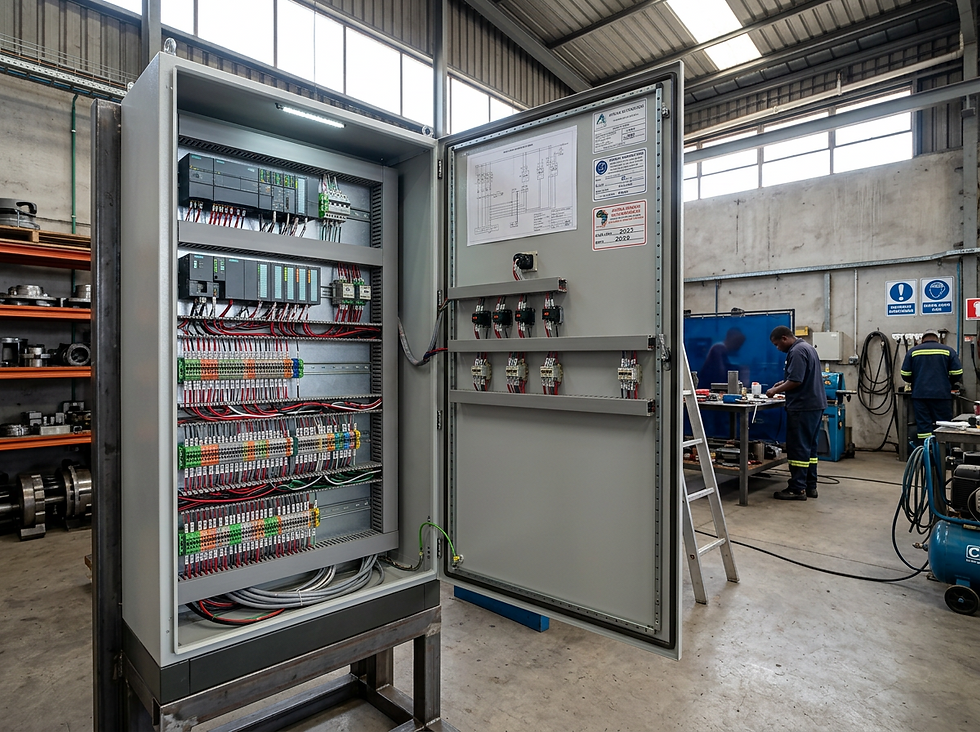
That means clear electrical drawings, updated mechanical layouts, I/O lists, network diagrams, backups, parameter records, alarm descriptions, and recovery procedures. It means panel labels match the drawings. Field devices are labelled in a way that makes sense on the floor. PLC comments are useful. SCADA alarms tell the operator what is wrong, not only that something is wrong.
It also means giving technicians access to the right tools. If the plant cannot go online with the PLC, check drive faults, view trends, or confirm instrument readings, diagnosis becomes slow and dependent on outside help.
A common mistake is to treat documentation as a commissioning formality. In reality, documentation is part of the maintenance system. Poor documentation turns every fault into an investigation.
Good maintainability also comes from standardisation. Plants do not need every machine to be identical, but they benefit when panels, sensors, drives, naming conventions, network layouts, and software backup practices follow a standard. This makes training easier and reduces the learning curve when technicians move between lines.
In older plants around the Vaal, Ekurhuleni, the West Rand, and parts of KwaZulu-Natal and the Western Cape, mixed equipment is normal. New automated cells often sit next to older mechanical equipment. That is not a problem by itself. The challenge is making sure the whole plant can be supported as one production system, rather than a collection of disconnected machines.
Plants have several practical choices
There is no single answer for every factory. A high-volume packaging plant in Gauteng will have different needs from a batch chemical process, a metal fabrication workshop, or a component assembly line. But the options are clear.
Developing internal skills is the strongest long-term path. This takes time and structure. It means planned exposure, mentoring, fault reviews, formal training where needed, and giving technicians time to learn systems before they fail. Sending someone on a course helps, but it does not replace guided experience on the plant’s own equipment.
Cross-training is often the quickest way to close risky gaps. An electrician does not need to become a mechanical specialist, but they should understand how a worn bearing or jammed actuator affects the sequence. A fitter does not need to write PLC code, but they should know how sensors, interlocks, and stops relate to mechanical movement. The goal is not to blur accountability. The goal is better first-line diagnosis.
Improving documentation is one of the most underrated maintenance investments. Drawings, backups, parameter sheets, alarm lists, recovery procedures, and critical spares information should be treated as live assets. If they are only updated during major projects, they will not reflect the plant that maintenance actually works on.
Using experienced external specialists also has a place. Some plants do not need full-time controls or robotics expertise on site. Others need independent support for audits, fault finding, upgrades, training, or recovery after recurring breakdowns. The right external partner should strengthen the internal team, not create permanent dependency.
For South African manufacturers, resilience matters. Power interruptions, ageing infrastructure, supply chain delays, and skills shortages all place extra pressure on maintenance. An automated plant with weak support becomes fragile. An automated plant with strong maintenance capability becomes a serious competitive advantage.
Frequently asked questions
Does automation reduce maintenance workload?
It can reduce some manual adjustments and repetitive interventions, but it does not remove maintenance. It shifts the work towards diagnostics, controls, instrumentation, drives, networks, and system reliability.
Should every maintenance technician learn PLC programming?
Not every technician needs to write PLC code. Many should be able to read basic logic, check inputs and outputs, understand interlocks, and use PLC information during fault finding.
Why do automated machines keep having repeat faults?
Repeat faults often come from unresolved root causes. These may include poor sensor setup, mechanical wear, unstable utilities, incorrect parameters, weak documentation, or teams resetting faults without understanding the original trigger.
Is external support better than building internal skills?
The best approach is usually a mix. Internal teams need enough knowledge to respond quickly and safely. External specialists can help with complex faults, upgrades, audits, training, and areas where full-time expertise is not practical.
What is the first step towards a more maintainable automated plant?
Start with the systems that cause the most downtime. Check drawings, backups, alarm quality, critical spares, skills coverage, and recurring fault history. This usually shows where maintainability is weakest.

The real measure of automation is uptime
Automation should make a factory more capable. It should improve quality, repeatability, safety, traceability, and output. But none of that holds if the plant cannot maintain the systems it installs.
A sophisticated factory needs sophisticated maintenance thinking. That does not always mean more people or more expensive tools. It means better skills, clearer ownership, stronger documentation, cleaner diagnostics, and a realistic view of what the equipment demands after commissioning.
The central lesson is simple: the more sophisticated a factory becomes, the more important its maintenance capability becomes.
Can we maintain what we’re automating?



Comments