

How to Get PLC and HMI Systems Installed in Akasia from Start to Finish
A PLC and HMI installation is not just a programming task. It is an engineering project that affects machine safety, production output, maintenance response times and operator control. In an industrial area such as Akasia, where factories often run a mix of new machinery, older equipment and locally modified systems, the installation must be planned with care from the first site visit.
For manufacturers in Pretoria and Gauteng, the right approach is to treat PLC and HMI work as a complete control system project. That includes requirements assessment, hardware selection, PLC programming, HMI screen development, panel building, electrical installation, testing, commissioning and handover documentation.
Emenem Industrial, based in the Pretoria and Rosslyn area, provides industrial automation and engineering services that support this type of work, including PLC design, control systems, electrical engineering, programming and system integration. This guide explains what businesses should expect when sourcing and planning a PLC and HMI installation Akasia project.

Start with a clear requirements assessment
Every reliable PLC and HMI project starts with understanding the machine or process. This step defines what the system must control, what information operators need and how the automation must fit into production.
For a new machine, the assessment usually focuses on the intended sequence of operation, motor control, sensors, interlocks, operator commands and production data. For existing equipment, the integrator also needs to understand the current wiring, control philosophy, faults, limitations and any modifications made over time.
A good requirements assessment should cover:
The machine function and operating sequence
Inputs such as sensors, switches, encoders and feedback devices
Outputs such as contactors, drives, valves, alarms and actuators
Safety circuits and emergency stop requirements
Operator actions during start-up, running, changeover and shutdown
Fault conditions and reset procedures
Communication with drives, instruments, remote I/O or plant systems
Space, heat and environmental conditions around the control panel
This early work prevents costly assumptions later. For example, a packaging machine may appear simple until the team identifies multiple changeover modes, product counters, jam detection, drive speed references and alarm histories. Those details affect PLC memory, I/O count, HMI screen structure and commissioning time.
Choose the right PLC and HMI hardware
The PLC is the control system’s decision-maker. It reads inputs, runs logic and controls outputs. The HMI is the operator’s window into that system, showing machine status, alarms, setpoints, production data and manual controls.
Hardware selection should never be based only on what is cheapest or readily available. It must match the machine, the environment and the support requirements. The integrator should consider:
PLC capacity
The PLC must have enough processing capacity, memory and expansion options for the current machine and any expected additions.
I/O requirements
Digital inputs, digital outputs, analogue signals, high-speed counters and special modules must be counted accurately. Spare capacity is useful, especially for future sensors or minor machine changes.
HMI size and layout
A small HMI may be suitable for a basic machine, while a larger screen may be needed for trend data, recipes, multi-zone control or detailed fault information.
Communication protocols
Modern equipment may use Ethernet/IP, PROFINET, Modbus TCP, Modbus RTU, serial links or other industrial protocols. The chosen PLC and HMI must support the devices that need to communicate. Compatibility should be checked, not assumed.
Environmental rating
Panels and HMIs installed in dusty, hot or washdown areas need suitable enclosure ratings, cooling and mounting methods.
This is why PLC integration should be treated as an engineering decision rather than a purchasing exercise. A capable PLC system integrator Pretoria businesses work with should explain why specific components are suitable, where the limitations are and what alternatives exist.
Plan the system design before programming starts
Once the requirements are clear, the integrator should produce a control system design. This links the process requirements to the actual PLC, HMI, electrical panel and field wiring.
The design stage usually includes an I/O list, control philosophy, panel layout, communication architecture and electrical schematics. It should also consider how the operator will use the machine in real production conditions.
For example, an HMI alarm screen should not simply list every fault. It should help the operator or maintenance technician find the cause. A useful alarm might identify the device, the condition and the likely area to inspect, such as a motor overload, low air pressure signal or guard circuit fault.
The design stage should also define how manual mode, automatic mode, interlocks and reset conditions will work. If this is not agreed early, commissioning can become difficult because the mechanical, electrical and production teams may each expect different machine behaviour.
For industrial automation Akasia projects, practical site factors also matter. Panel access, cable routes, downtime windows, spare parts availability and maintenance standards should all feed into the design.
Build the PLC programme around the machine sequence
PLC programming turns the agreed control philosophy into working machine logic. The programme should be structured clearly so it can be tested, maintained and modified when needed.
Good PLC programming covers more than start and stop commands. It often includes:
Automatic and manual operation
Interlocks and permissives
Timers, counters and sequence steps
Motor and drive control
Analogue scaling
Fault detection and alarms
Machine status signals
Communication with HMIs, drives and instruments
For businesses looking for PLC programming Pretoria services, clarity is as important as technical skill. Maintenance teams should be able to follow the logic when diagnosing a machine problem. Programmes that are poorly structured, undocumented or locked without agreement can make future support harder.
PLC code should also be tested in stages. Where possible, parts of the logic can be checked before installation. During commissioning, the integrator should test each input and output, then test machine sequences under controlled conditions.

Develop the HMI for operators and maintenance teams
HMI development should focus on usability. Operators need clear screens that help them run the machine safely and consistently. Maintenance teams need diagnostics that reduce time spent tracing faults.
A practical HMI design may include:
Main overview screen
Manual controls
Automatic operation status
Recipe or setpoint screens
Alarm list and alarm history
Maintenance and diagnostic pages
Production counters or basic reporting
User access levels where required
For HMI programming Pretoria projects, screen layout matters. Critical information should be visible without forcing operators through too many pages. Colours should be used consistently. Alarm messages should be plain enough to understand during a breakdown.
An HMI is not a substitute for safe machine design, sound electrical installation or operator training. It is an interface that supports the control system. Its value comes from accurate status information, clear prompts and reliable communication with the PLC.
Build the control panel and complete the electrical installation
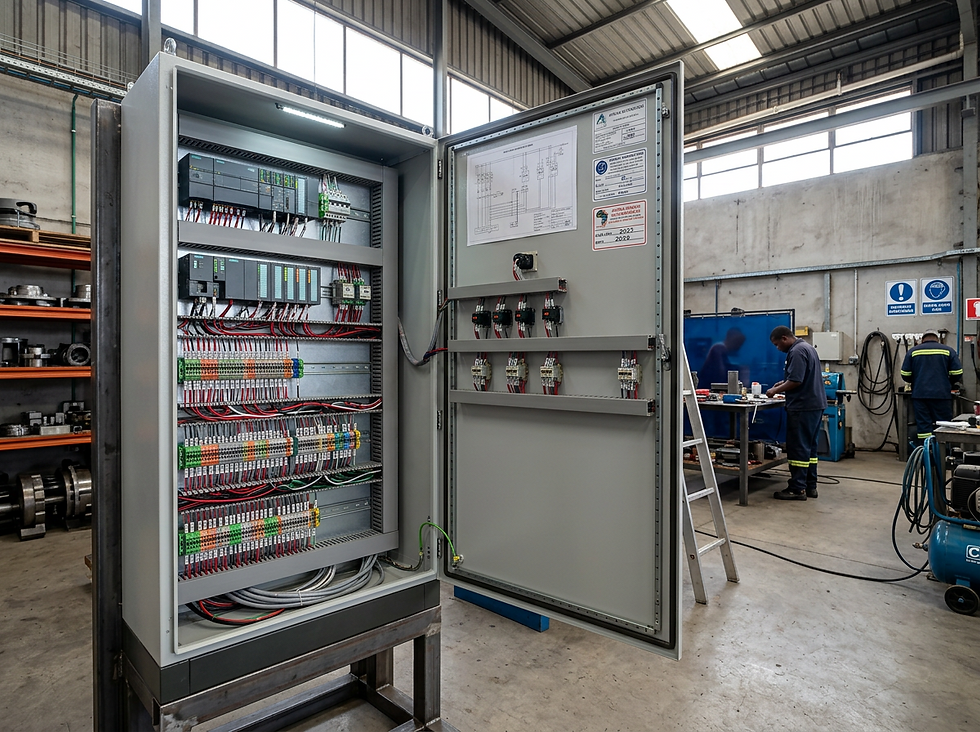
Control panel building brings the design into a physical form. This includes mounting the PLC, HMI interface equipment, power supplies, protection devices, terminals, relays, drives and communication hardware inside the enclosure.
Panel quality affects long-term reliability. Neat wiring, clear labelling, correct segregation of power and control circuits, sufficient ventilation and accessible terminals make a real difference during maintenance.
Electrical installation then connects the control panel to the machine. This may involve cable trays, field wiring, sensor mounting, actuator wiring, motor connections, earthing and communication cabling.
Control panel installation Pretoria projects should allow enough time for site work. Factories often have space restrictions, live production areas and limited shutdown windows. The installation plan should account for safe isolation, lockout requirements, cable routing and production access.
A new installation often allows cleaner planning because the machine, panel and field equipment can be designed together. A retrofit is more complex. It may involve old drawings, undocumented wiring, obsolete components, limited panel space or existing machine behaviour that operators rely on. Retrofitting requires careful investigation before removing or replacing controls.
Test, commission and hand over the completed system
Testing and commissioning prove that the system works as intended. This is where design, programming, panel work and installation come together.
Testing usually starts with basic electrical checks and I/O verification. Each input must activate correctly in the PLC. Each output must operate the correct device. Analogue signals must be scaled and checked against real values.
PLC commissioning then moves into sequence testing. The integrator checks modes, interlocks, alarms, resets, start-up operation, stopping behaviour and fault recovery. HMI commissioning checks screen navigation, buttons, setpoints, alarm messages, status indicators and communication with the PLC.
Commissioning should involve production and maintenance personnel where practical. Operators know how the machine is used during real production. Maintenance teams know which faults are common and which diagnostics will help them respond faster.
Before handover, the final installation should include agreed technical deliverables. These may include:
Updated electrical schematics
PLC and HMI backup files
I/O list
Panel layout drawings
Device settings, where relevant
Network or communication details
Alarm list
Operating instructions
Basic maintenance guidance
Commissioning records
These deliverables are not paperwork for the sake of paperwork. They protect the business when components fail, production changes or future upgrades are required.
Know what to provide when requesting a quotation
A clear quotation request helps the automation integrator price the work accurately and avoid broad assumptions. It also helps the business compare proposals on the same basis.
When requesting a quotation for PLC installation Akasia, HMI installation Akasia or broader industrial automation Pretoria work, provide as much practical information as possible. Useful information includes the machine type, current control system, available drawings, photos of the panel, fault history, required functions, preferred hardware brands if any, site constraints and expected downtime windows.
For a new system, include the process description, machine sequence, motor list, sensor list and any supplier documentation. For a retrofit, include details of the existing PLC, HMI, drives, instruments and field devices. If drawings are outdated, say so. That allows the integrator to include time for tracing and verification.
A professional proposal should explain the scope clearly. It should separate design, programming, panel building, installation, testing, commissioning and documentation where appropriate. It should also state exclusions, assumptions and dependencies, such as client-supplied equipment, shutdown access or mechanical readiness.
Prepare for common installation challenges
PLC and HMI projects can be affected by issues that are not visible at the quotation stage. Planning reduces the risk, but factories should still allow for practical challenges.
Common issues include missing drawings, damaged field devices, incorrect cable labelling, old components with limited communication options, insufficient panel space and electrical noise affecting signals. Retrofits may also reveal control habits that developed over years but were never documented.
Communication can also cause delays. Devices may support the same general protocol but require specific settings, mapping or firmware compatibility. Analogue signals may need calibration. Imported machines may use unfamiliar wiring conventions or documentation that does not match the installed equipment.
For industrial automation Gauteng projects, site coordination is often just as important as programming. A commissioning window can be lost if the machine is not mechanically ready, power is unavailable or production cannot release the equipment as planned.
Good communication between the manufacturer, integrator, electrical team, machine supplier and production staff keeps the project moving.
Work with an integrator that supports the full control system lifecycle
An automation integrator should do more than load a PLC programme. The right partner understands electrical design, control panel construction, PLC and HMI development, installation conditions, commissioning and long-term support.
Emenem Industrial operates from the Pretoria and Rosslyn area and supports industrial automation Akasia and surrounding Gauteng manufacturing environments. Its engineering focus includes PLC design, PLC programming, HMI development, control systems, electrical engineering and system integration for industrial equipment.
That local engineering context matters when fast site response, practical fault-finding and clear technical communication are needed. It also helps when the project involves a mix of older machinery, new equipment and production requirements that cannot be paused for long periods.
For more detail on PLC design, panel building and schematics, visit Emenem Industrial’s PLC design, building and schematics service page.
A successful PLC and HMI installation is planned before it is programmed
The best results come from a disciplined process. Define the machine requirements. Select suitable PLC and HMI hardware. Confirm the I/O and communication needs. Design the control system. Build the panel correctly. Install the field wiring carefully. Test each function. Commission with the people who will operate and maintain the machine.
For Akasia manufacturers, this approach reduces uncertainty and gives the plant a control system that is easier to operate, maintain and support. Whether the project is a new installation or a retrofit, documentation, training and ongoing technical support should be part of the plan from the start.



Comments