

What Is Included in Turnkey Industrial Automation Solutions?
Turnkey industrial automation can include the full project path: initial scope definition, engineering, hardware selection, PLC programming, HMI programming, SCADA integration, control panels, system integration, installation, testing, commissioning, documentation, training and final handover. In practical terms, it means one automation partner takes responsibility for coordinating the main technical activities needed to deliver a working automation system.
For manufacturers, plant managers, engineers, maintenance teams and procurement teams, the value lies in clarity. A turnkey scope should explain what is included, what is excluded, who supplies what, how the system will be tested, and what the plant receives at handover.
Emenem Industrial is a Pretoria/Rosslyn-based industrial automation and engineering company supporting industrial automation projects in Gauteng and beyond. This article explains what is normally included in turnkey industrial automation solutions, where the scope can vary, and what information helps produce a clear quotation.

What turnkey industrial automation means
Turnkey industrial automation means the automation supplier manages a defined project from concept through to operational handover. The word “turnkey” is often used loosely, so it should always be tied to a written scope.
A proper turnkey automation scope usually answers these questions:
What process, machine or production area is being automated?
What engineering work is included?
Which hardware and software platforms will be used?
Who is responsible for panels, cabling, installation and site work?
How will PLC, HMI and SCADA functions be tested?
What documentation and training will be handed over?
What support is included after commissioning?
This approach differs from buying individual services separately. For example, a plant may appoint one supplier for control panel manufacturing, another for PLC programming, another for electrical installation and another for commissioning. That can work, but it increases the need for internal coordination. With turnkey industrial automation, one appointed automation system integrator is responsible for aligning the technical pieces within the agreed limits of supply.
The key phrase is agreed limits of supply. Turnkey does not automatically mean “everything imaginable”. It means everything listed in the quotation, technical proposal and project scope.
What is typically included in a turnkey automation project
Most turnkey automation projects follow a similar sequence, even though the details vary by industry, equipment and process complexity.
A typical scope may include:
Project area | Typical inclusion |
Scope definition | Site review, process discussion, control philosophy and functional requirements |
Engineering | Electrical design, control architecture, I/O planning and network layout |
Hardware | PLCs, HMIs, sensors, drives, instrumentation and related automation equipment |
Control panels | Panel design, component selection, assembly and testing |
Software | PLC programming, HMI programming and SCADA configuration where required |
Integration | Connecting equipment, instruments, drives, safety devices and plant systems |
Installation | Electrical installation, cabling, panel placement and field device connection |
Testing | Factory checks, I/O testing, functional testing and fault checks |
Commissioning | Start-up, process proving, adjustments and operator support |
Handover | Drawings, backups, manuals, training and project close-out documents |
For procurement teams, this structure helps compare quotations properly. One quotation may include installation and commissioning, while another may quote only programming and panels. The lower price may not represent the lower total project cost if important site work is excluded.
PLC, HMI, SCADA and system integration
The control system is the centre of most industrial automation systems. This is where site requirements become working automation logic, operator controls and plant data.
PLC programming
A PLC, or programmable logic controller, controls machines and processes based on inputs, outputs and programmed logic. PLC programming may include:
Start, stop and reset sequences
Motor and actuator control
Interlocks and permissives
Alarm handling
Safety-related control interfaces, where applicable
Step sequences and batch logic
Analogue control for pressure, temperature, level or flow
Communication with drives, instruments and other controllers
Good PLC automation solutions are not only about making equipment run. They must be maintainable. Fault messages should make sense. The programme structure should be clear enough for future troubleshooting. Inputs and outputs should be labelled logically.
HMI programming
An HMI, or human-machine interface, gives operators a visual way to control and monitor the system. HMI programming may include:
Process overview screens
Machine control screens
Alarm pages
Trend displays
Setpoint entry
Maintenance screens
Operator guidance messages
A useful HMI reduces guesswork. Operators should be able to see what the machine is doing, why it is stopped and what action is required. Clear HMI design also helps maintenance teams diagnose faults faster.
SCADA integration
SCADA, or supervisory control and data acquisition, is used when a plant needs higher-level monitoring, control and data collection. SCADA integration may include:
Plant-wide process visualisation
Alarm management
Historical trending
Data logging
Reporting functions
Communication with PLCs and remote equipment
User access control
Not every project needs SCADA. A standalone machine may only need a local HMI. A production area with multiple lines, tanks, utilities or remote stations may benefit from SCADA. The decision should be based on operational need, not on adding complexity for its own sake.
System integration
Industrial system integration is the work of making different parts of the plant communicate and operate together. This can include PLCs, HMIs, VSDs, servo drives, instruments, sensors, barcode scanners, weighing systems, safety devices and existing equipment.
For an industrial automation integrator, integration work often carries the most risk because it depends on details from several suppliers. Communication protocols, electrical interfaces, signal types and control responsibility must be confirmed early.
Control panels, electrical work and hardware
Control panels are a visible part of many turnkey automation projects, but they are only one part of the full control system.
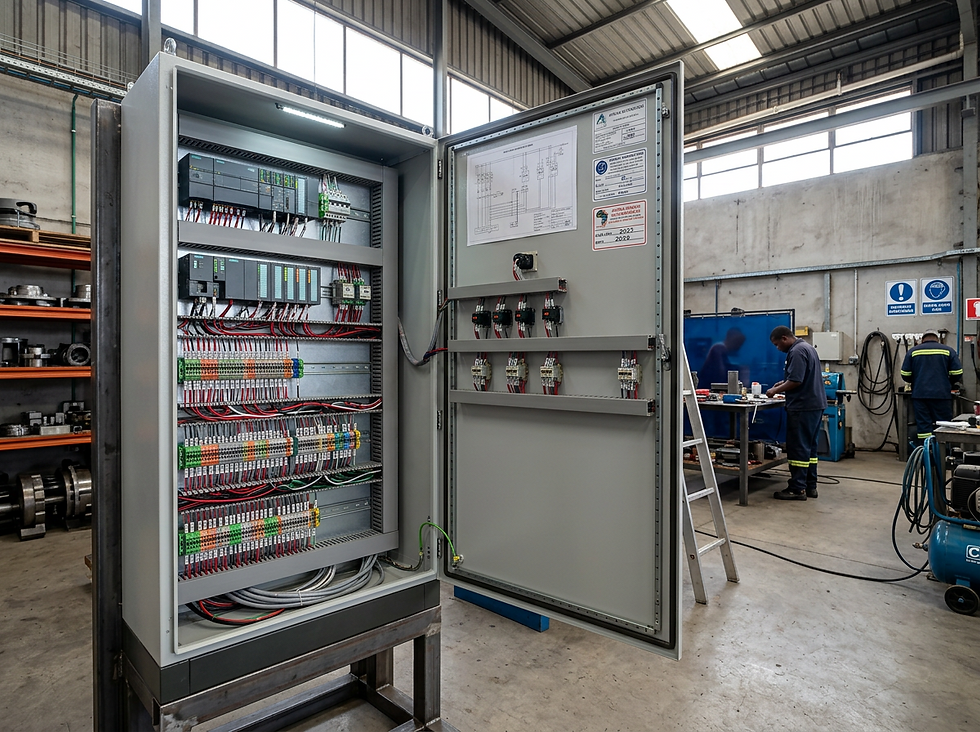
Control panel design normally considers:
Electrical load and power distribution
PLC and remote I/O layout
Motor starters and drives
Protection devices
Terminals and wiring routes
Ventilation or cooling requirements
Labelling
Space for maintenance access
Compliance with relevant electrical practices and site standards
Control panel manufacturing then turns the design into a physical assembly. This may include enclosure preparation, component mounting, wiring, ferruling, labelling and panel testing before delivery to site.
Hardware selection is also important. The automation supplier must choose equipment that suits the environment, process requirements and maintenance strategy. In a dusty, wet, hot or vibration-prone environment, device selection and enclosure ratings matter. In a plant that already uses a specific PLC platform, compatibility may be a commercial and maintenance priority.
Electrical work may include cable routing, cable termination, field device installation, panel installation and connection to machines or process equipment. The exact electrical scope should be stated clearly, especially where there are separate electrical contractors on site.

Installation, testing and commissioning
Installation and commissioning are where design assumptions meet plant reality. This phase needs careful planning, especially when work takes place during shutdowns or limited production windows.
Installation
Installation may include:
Mounting control panels
Installing sensors and instruments
Running and terminating cables
Connecting motors, drives and actuators
Installing operator stations
Connecting network and communication cables
Checking earthing and electrical protection
Updating field wiring to match drawings
Good installation practice reduces commissioning delays. Cable labels, terminal markings and field device tags should match the drawings and PLC I/O list. Small inconsistencies can cost hours during fault-finding.
Testing
Testing can happen in stages.
Factory acceptance testing, often called FAT, checks the system before it goes to site. This may include panel checks, PLC software simulation, HMI screen review and basic sequence testing.
Site acceptance testing, often called SAT, checks the system after installation. This may include I/O checks, instrument calibration checks, machine movement tests, interlock verification and operator function tests.
Not every project needs a formal FAT and SAT process, but every project needs an agreed testing method.
Commissioning
Automation commissioning brings the system into operation. It may include:
Power-up checks
PLC and HMI download
Network and communication checks
Field device testing
Dry runs without product
Wet runs or production trials
Alarm and trip testing
Adjustments to timers, limits and setpoints
Operator support during start-up
Commissioning should be controlled and recorded. A good commissioning process protects equipment, reduces downtime and gives the plant confidence that the system performs as intended.
Documentation, training and handover
A turnkey project is not complete when the equipment starts for the first time. The plant also needs the information required to operate, maintain and support the system after the project team leaves site.
Typical documentation may include:
Electrical drawings
Control panel drawings
I/O lists
Network layouts
PLC and HMI backups
SCADA configuration backups, where applicable
Device manuals
Alarm lists
Test records
Commissioning sheets
Operator guidance documents
Training should match the people who will use the system. Operators may need start-up, shutdown, alarm response and normal operation training. Maintenance teams may need fault-finding guidance, drawings, backup locations and safe reset procedures.
A proper handover also confirms what changed during commissioning. Site changes should be reflected in the final documentation. As-built drawings are far more useful than original design drawings that no longer match the installed system.
What may vary by project
Turnkey automation projects are not all the same. The inclusions depend on the plant, process, equipment and level of responsibility assigned to the supplier.
The following items often vary:
Mechanical design and fabrication
Pneumatics and hydraulics
Instrument supply and calibration
Civil work, trenching or plinths
Network infrastructure outside the machine or process area
Safety system design and validation
Integration with ERP, MES or production reporting systems
Shutdown planning
Spares supply
Ongoing support after handover
Some projects are greenfield. Others involve an old machine with limited documentation. Some require work on a live plant where downtime is costly. Others can be fully built and tested off-site before installation.
This is why a short site assessment or technical discussion is often valuable before finalising a quotation. A clear scope protects both the plant and the automation supplier.
What information is needed for a quotation
A good quotation for industrial automation services depends on good input information. The more accurate the starting point, the more reliable the proposal.
Useful information includes:
A description of the process or machine
The current problem or required improvement
Existing drawings, manuals or PLC backups
Preferred PLC, HMI or SCADA platforms, if any
Number and type of motors, instruments and sensors
Required operator controls and alarm functions
Available power supply and panel locations
Communication requirements
Site photos or a site walkdown
Production constraints and shutdown windows
Safety requirements and site rules
Required documentation and training
Target delivery dates
For procurement teams, it also helps to state what format is needed. Some projects require a budget estimate first. Others need a formal technical and commercial proposal. For larger turnkey automation projects, a staged approach may be more accurate, starting with assessment and engineering before final supply pricing.
How to choose an automation partner
Choosing an automation partner is not only about price. A good partner should understand the plant environment, ask practical questions and explain the scope clearly.
Look for an automation system integrator that can:
Define the control philosophy before programming starts
Explain what is included and excluded
Work with existing plant standards
Produce clear electrical and control documentation
Build maintainable PLC and HMI systems
Plan testing and commissioning properly
Communicate risks early
Support handover with backups, drawings and training
For projects in Pretoria, Rosslyn and surrounding industrial areas, location can help with site visits, installation planning and commissioning support. Companies searching for industrial automation Pretoria or industrial automation Gauteng are often looking for a supplier who can work close to the plant while still understanding industrial project controls, safety requirements and production pressures.
Emenem Industrial’s positioning as a Pretoria/Rosslyn-based industrial automation and engineering company makes it relevant for manufacturers evaluating local industrial automation engineering support. As with any project, the right fit depends on the scope, schedule, technology requirements and responsibilities agreed upfront.
Frequently asked questions
What is included in turnkey industrial automation solutions?
Turnkey industrial automation solutions can include scope definition, engineering, hardware supply, control panels, PLC programming, HMI programming, SCADA integration, installation, testing, commissioning, documentation, training and handover. The exact inclusions must be confirmed in the quotation and technical scope.
Does every turnkey automation project include SCADA?
No. SCADA is only needed when the plant requires higher-level monitoring, data logging, trends, alarms or centralised control. A smaller machine or process may only require a PLC and HMI.
Are control panels always included?
Not always. Many turnkey automation projects include control panel design and control panel manufacturing, but some projects use existing panels or have panels supplied by another contractor. This should be clarified early.
What is the difference between PLC programming and system integration?
PLC programming focuses on the controller logic that runs the machine or process. System integration connects the PLC with other devices and systems, such as HMIs, SCADA, drives, instruments, remote I/O and existing plant equipment.
What should be checked before accepting a turnkey quotation?
Check the technical scope, exclusions, hardware assumptions, software platforms, delivery responsibilities, installation scope, testing method, commissioning support, documentation, training and after-handover support. Also confirm who is responsible for site access, shutdown planning and any third-party equipment.
A practical way to define the scope
The best turnkey automation projects start with a clear conversation about the plant’s actual requirements. Before requesting pricing, define the process, the pain points, the existing equipment, the required controls and the handover expectations.
A well-scoped project gives plant teams better cost control, clearer responsibilities and fewer surprises during commissioning. It also helps the automation partner design, build and test an industrial automation system that maintenance teams can support long after handover.



Comments