

Understanding PLC and HMI Systems in South African Industrial Automation
Industrial automation is transforming manufacturing across South Africa, especially in key hubs like Gauteng, Pretoria, Johannesburg, Centurion, Midrand, and Rosslyn. For engineers, plant managers, and decision-makers, understanding the role of Programmable Logic Controllers (PLCs) and Human-Machine Interfaces (HMIs) is essential to improving production efficiency, safety, and control. This article explains what PLCs and HMIs are, how they work together, their benefits, common applications, and best practices for successful implementation in South African manufacturing environments.

What Are PLCs and HMIs?
PLCs (Programmable Logic Controllers) are rugged industrial computers designed to control machinery and processes. They receive inputs from sensors and switches, process the data based on programmed logic, and send commands to actuators such as motors, valves, or relays. PLCs are built to operate reliably in harsh factory conditions and provide precise control over manufacturing processes.
HMIs (Human-Machine Interfaces) are user-friendly devices that allow operators to interact with the automation system. Typically featuring touchscreens or displays, HMIs show real-time data, system status, alarms, and controls. They enable operators to monitor processes, adjust settings, and respond quickly to issues.
Together, PLCs and HMIs form the backbone of industrial automation systems, providing both control and visibility.
How PLCs and HMIs Work Together in Industrial Automation
In a typical automation setup, the PLC acts as the brain, executing control logic and managing equipment. The HMI serves as the communication bridge between the operator and the PLC. The PLC collects data from sensors and executes control commands, while the HMI displays this data in an understandable format.
For example, in a bottling plant in Johannesburg, the PLC controls conveyor belts, filling machines, and packaging robots. The HMI displays the current production rate, machine status, and alerts operators if a fault occurs. Operators can use the HMI to adjust speeds or reset machines without needing to access the PLC directly.
This collaboration improves operational efficiency and reduces downtime by enabling quick responses to changing conditions.
What Are the Benefits of PLC HMI Design in Industrial Automation?
PLC HMI design offers several key benefits for South African manufacturers:
Improved Efficiency
Automation reduces manual intervention, speeds up processes, and maintains consistent quality.
Real-Time Monitoring
Operators can see live data and system status, allowing for faster decision-making.
Operator Control
HMIs provide intuitive controls for adjusting parameters without needing programming skills.
Data Collection and Analysis
PLCs log production data that can be used for performance analysis and predictive maintenance.
Enhanced Safety
Automation can include safety interlocks and emergency stops, reducing risk to workers.
Scalability
Systems can be expanded or modified as production needs change.
Reduced Downtime
Early fault detection and remote diagnostics help prevent prolonged stoppages.
These benefits are especially valuable in Gauteng’s competitive manufacturing sector, where uptime and quality directly impact profitability.
Common Industrial Applications of PLC and HMI Systems
PLCs and HMIs are widely used across various manufacturing sectors in South Africa, including:
Automotive Assembly
Controlling robotic arms, conveyors, and paint booths in plants around Rosslyn.
Food and Beverage Processing
Managing filling, packaging, and quality control in factories in Midrand and Pretoria.
Mining Equipment Automation
Operating crushers, conveyors, and ventilation systems in mining operations.
Textile Manufacturing
Controlling looms, dyeing machines, and cutting equipment.
Chemical Processing
Monitoring reactors, pumps, and safety systems.
Each application benefits from tailored PLC programming and HMI design to meet specific operational requirements.
Integration with Custom Machines, Robotics, Vision Systems, and Production Lines
Modern manufacturing often involves complex systems combining custom-built machines, robotics, and vision inspection systems. PLCs provide the central control logic, coordinating these components to work seamlessly.
For example, a Gauteng-based manufacturer might use a PLC to synchronize robotic arms with a vision system that inspects parts for defects. The HMI displays inspection results and allows operators to adjust robot paths or reject faulty items automatically.
Integration requires careful design of PLC control panels and detailed electrical schematics to ensure all components communicate reliably and safely.
The Role of PLC Control Panels and Electrical Schematics in Automation Projects
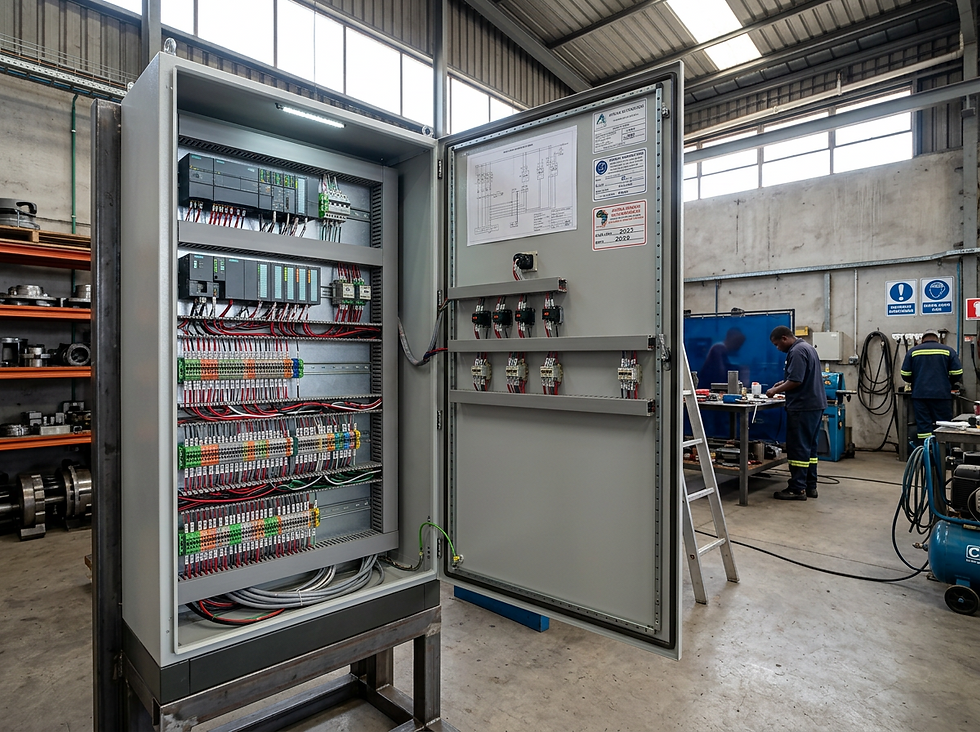
PLC control panels house the PLC hardware, power supplies, input/output modules, and wiring connections. These panels must be designed to industrial standards, ensuring safety, accessibility, and ease of maintenance.
Electrical schematics provide detailed diagrams showing how components connect and interact. They are essential for installation, troubleshooting, and future upgrades.
In South African manufacturing plants, well-designed control panels and clear schematics reduce installation time and minimise errors, supporting smooth automation deployment.
Best Practices for PLC and HMI Design
To maximise the benefits of PLC and HMI systems, manufacturers should follow these best practices:
Understand Process Requirements
Collaborate with engineers and operators to define control logic and interface needs.
Keep HMI Interfaces Simple and Clear
Use intuitive layouts, clear labels, and avoid clutter to reduce operator errors.
Use Standardised Programming
Follow industry standards for PLC code to improve maintainability.
Plan for Scalability
Design systems that can be expanded or modified as production evolves.
Test Thoroughly Before Deployment
Simulate processes and validate control logic to catch issues early.
Provide Operator Training
Ensure staff understand how to use the HMI and respond to alarms.
Maintain Documentation
Keep updated schematics, code comments, and manuals for future reference.
Common Mistakes Manufacturers Should Avoid When Implementing PLC HMI Systems
Manufacturers sometimes face challenges due to:
Overcomplicated HMI Screens
Too much information can overwhelm operators.
Ignoring Operator Input
Failing to involve end-users in design leads to impractical interfaces.
Poor Documentation
Lack of clear schematics and code comments complicates troubleshooting.
Underestimating Training Needs
Operators unfamiliar with the system may cause errors or delays.
Neglecting Maintenance Planning
Without regular updates and checks, systems degrade over time.
Avoiding these pitfalls helps ensure automation projects deliver lasting value.
FAQ
What is the difference between a PLC and an HMI?
A PLC is an industrial computer that controls machines and processes by executing programmed logic. An HMI is the user interface that allows operators to monitor and control the PLC and the system it manages.
What are the benefits of PLC HMI design?
PLC HMI design improves efficiency, provides real-time monitoring, enhances operator control, supports data collection, increases safety, allows scalability, and reduces downtime.
How do HMIs improve manufacturing efficiency?
HMIs display live data and system status, enabling operators to make quick adjustments and respond to faults promptly, which keeps production running smoothly.
Can PLC and HMI systems be integrated into existing equipment?
Yes, many PLC and HMI systems can be retrofitted to existing machinery, allowing manufacturers to upgrade automation without replacing entire lines.
Which industries use PLC HMI systems?
Industries such as automotive, food and beverage, mining, textiles, and chemical processing commonly use PLC and HMI systems.
How long does a PLC HMI implementation project take?
Project duration varies depending on complexity but typically ranges from a few weeks for small systems to several months for large-scale automation projects.



Comments